Executive Summary
AI-enabled initiatives require governance models that are adaptive, evidence-based, human-accountable and continuously connected to value realization.
Traditional project governance remains useful, but it is insufficient on its own for AI-enabled initiatives because AI systems operate in conditions characterized by uncertainty, changing data, adaptive model behavior, regulatory change, vendor dependency, benefit drift, model drift, adoption variability and human impact.
This paper defines the AI Governance and Value Delivery Operating Model. It translates the conceptual ontology and taxonomy described in Paper 1 into a practical governance architecture for overseeing AI-enabled initiatives across their lifecycle.
The operating model is built around seven core concepts: adaptive governance, governance triggers, Human-in-Command authority, escalation and override, benefit and drift management, lifecycle governance and continuous value delivery.
The model incorporates AIPM Ambassador review feedback, cross-resource alignment, PRIISM, Resource 08 lifecycle cost and investment logic, Resource 11 benefits and ROI tracking, Resources 08 and 10 lifecycle decision support and financial authority, and alignment with PMI’s AI Standard for portfolio, program and project management.
The central message of this paper is that AI governance is not merely control. It is the continuous stewardship of responsible value delivery under uncertainty.
1. Introduction
Paper 1 established the conceptual foundation of the AI Governance and Value Delivery Ontology and Taxonomy Framework. It defined the core ontology, taxonomy, value delivery logic, semantic relationships and Human-in-Command principle.
This second paper answers a different question: how should AI-enabled initiatives be governed in practice?
The operating model recognizes that AI governance cannot be static. AI-enabled initiatives may begin with a valid business case, appropriate controls and strong expected benefits, yet later encounter model drift, benefit drift, data deterioration, adoption failure, regulatory change, vendor disruption, ethical concerns, stakeholder resistance, cost escalation or strategic misalignment.
For this reason, AI governance must operate as a continuous system of monitoring, decision-making, escalation, adaptation and accountability.
2. Governance Operating Model Purpose
The purpose of the AI Governance and Value Delivery Operating Model is to provide a structured approach for governing AI-enabled initiatives across their lifecycle.
2.1 Risk-Adjusted Governance
Not every AI-enabled initiative requires the same level of governance. Governance intensity should be tailored to business impact, regulatory exposure, human consequence, ethical risk, data sensitivity, autonomy level, financial exposure, uncertainty and strategic importance.
2.2 Early Detection
Governance should not wait until failure has occurred. The operating model uses triggers and monitoring indicators to detect emerging concerns early.
2.3 Human Accountability
AI may analyze, recommend, optimize, automate or monitor. Humans remain accountable for objectives, decisions, interventions, approvals and consequences.
2.4 Continuous Value Validation
- Are expected outcomes occurring?
- Are benefits being realized?
- Are risks increasing?
- Are costs changing?
- Are impacts positive, neutral or negative?
- Should the initiative continue, adapt, pause or retire?
2.5 Portfolio-Level Oversight
Organizations rarely govern one AI initiative in isolation. AI initiatives compete for funding, talent, infrastructure, data, vendor attention, governance capacity and organizational change bandwidth. Portfolio governance must therefore evaluate aggregate net impact, not merely the success of individual initiatives.
3. Operating Model Principles
Governance Is Proportional
Governance effort should be proportional to impact, uncertainty, risk and organizational consequences.
Governance Is Continuous
Governance does not end at deployment. Data, models, costs, assumptions, adoption, benefits and regulations may change over time.
Governance Is Trigger-Based
Governance action should be initiated when defined signals, thresholds, anomalies or changes indicate that review or intervention may be needed.
Governance Is Human-in-Command
AI may support governance, but humans retain authority, judgment and accountability.
Governance Protects Value
Governance should protect and enhance value by helping ensure that expected benefits, impacts and outcomes remain achievable.
Governance Manages Uncertainty
Uncertainty should be explicitly assessed, monitored and incorporated into decisions.
Governance Supports Adaptation
AI-enabled initiatives should be adapted when assumptions, risks, benefits, operating conditions or strategic priorities change.
Governance Enables Retirement
Ending or retiring an initiative may be the correct governance decision when future expected net impact is no longer positive.
4. PMI AI Standard Alignment
The PMI AI Standard strengthens the external alignment of this operating model. The AIPM framework remains distinct: PMI provides principles, performance domains and lifecycle guidance, while the AIPM framework provides a governance ontology, taxonomy, trigger architecture, benefit drift logic, PRIISM integration, and implementation architecture.
4.1 Alignment with PMI AI Principles
| PMI AI Principle | AIPM Operating Model Alignment |
|---|---|
| Strategic Value | Organizational objectives, portfolio governance, net impact and value delivery logic. |
| Risk | Governance triggers, uncertainty ontology, drift management, risk escalation and lifecycle monitoring. |
| Governance and Compliance | Governance controls, authority levels, escalation, override, legal/compliance triggers and audit evidence. |
| People and Culture | Human-in-Command, change management, organizational readiness and adoption governance. |
| Ethics and Professional Responsibility | Ethical triggers, fairness, explainability, transparency, human accountability and responsible AI controls. |
| Stakeholder Engagement | Stakeholder expectation management, adoption strategy, human impact triggers and communication rhythms. |
| Optimization and Innovation | Adaptive governance, scenario-based value assessment, portfolio optimization and continuous value delivery. |
| Data Quality | Data triggers, data governance, data readiness, lineage and AI quality/reliability profile. |
4.2 Alignment with PMI AI Performance Domains
| PMI AI Performance Domain | AIPM Paper 2 Incorporation |
|---|---|
| Managing Stakeholder Expectations About AI | Stakeholder expectation management, change management, adoption strategy and communication governance. |
| Defining the Scope for AI | AI solution fit, governance profile, business case boundaries and AI role in PPPM. |
| Designing AI Architecture With Quality and Reliability | AI quality and reliability profile, data quality, model validation, robustness, explainability, security and monitoring. |
| Executing Strategic AI Goals | Portfolio governance, lifecycle governance, PRIISM recommendation logic, and Value Owner accountability. |
| Managing AI Risks and Uncertainties | Governance triggers, uncertainty profile, scenario-based assessment, drift and escalation. |
4.3 AI as Tool, Deliverable, Operating Capability or Governance Capability
The operating model distinguishes four AI roles that carry different governance implications.
| AI Role | Governance Meaning |
|---|---|
| AI as a PPPM Tool | AI supports project, program, portfolio or PMO work, such as reporting, summarization, scheduling or risk analysis. |
| AI as a Project Deliverable | The project delivers an AI system, model, assistant, platform or workflow. |
| AI as an Operating Capability | AI becomes embedded in business operations or value streams. |
| AI as a Governance Capability | AI supports governance intelligence, copilots, agents, monitoring or decision support. |
5. Governance Trigger Architecture
Governance triggers are the core operating mechanism of adaptive AI governance. A governance trigger is a signal, condition, event, threshold, pattern or anomaly indicating that governance attention, review, escalation or corrective action may be required.
The Governance Trigger Architecture connects trigger categories, detection signals, severity assessment, governance response and adaptive action.
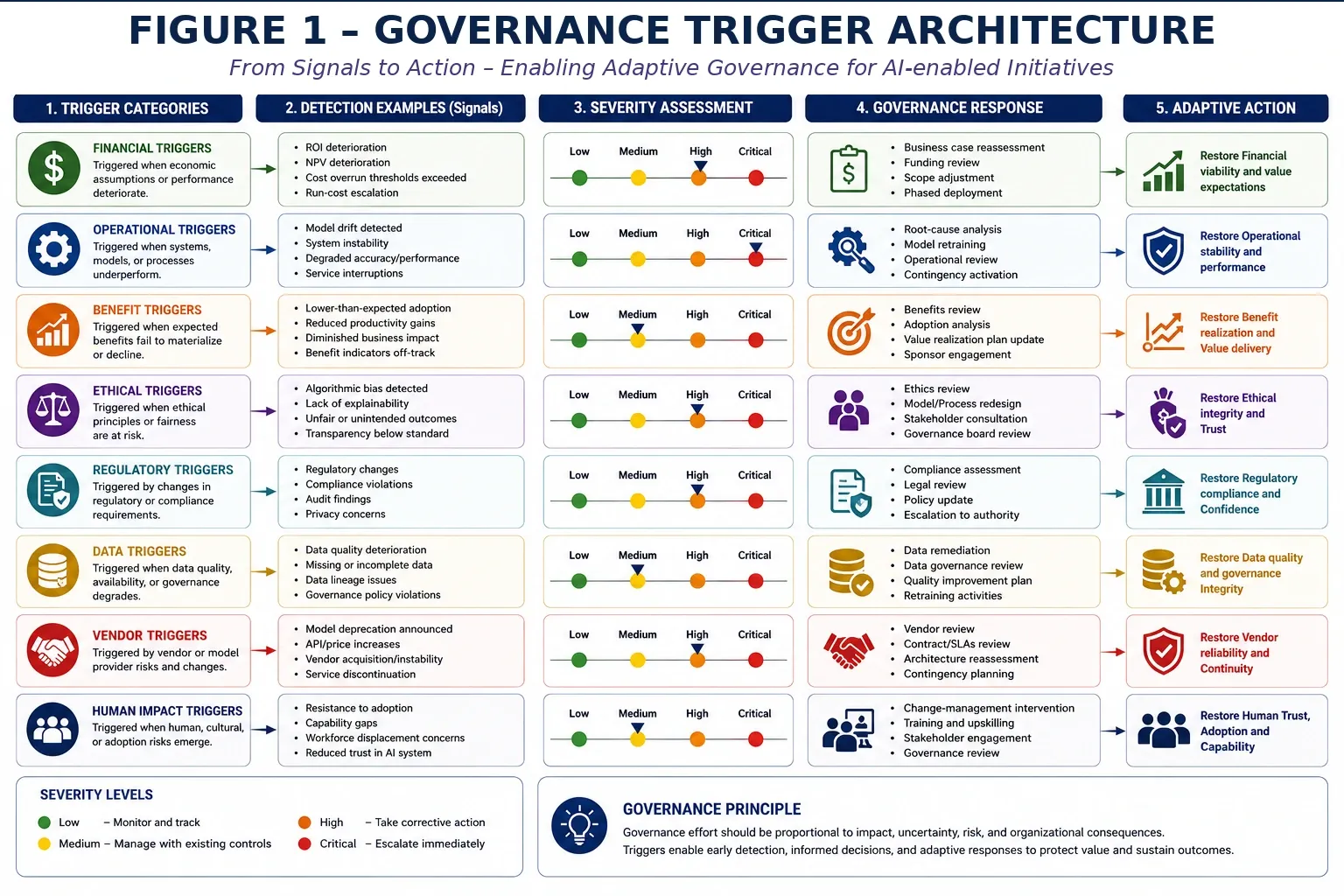
Figure 1. Governance Trigger Architecture. Trigger categories, detection examples, severity assessment, governance response and adaptive action.
Check Results – Governance Trigger Architecture
✓ Are trigger categories standardized across the framework?
✓ Are thresholds and owners defined?
✓ Is each trigger connected to a response pathway?
✓ Are unresolved triggers visible to the appropriate authority?
6. Governance Trigger Response Flow
The governance trigger response flow defines the standard operating sequence when a governance signal becomes governance-worthy.
The flow is: Trigger Detected → Classification → Severity Assessment → Governance Response → Corrective Action → Monitoring.
6.1 Signal versus Trigger
A signal is an observation, event, metric movement, comment, issue or anomaly. A signal becomes a governance trigger when it crosses a defined threshold, indicates material risk, invalidates an assumption, affects expected value, threatens compliance, affects stakeholders, or requires authority action.
| Concept | Definition |
|---|---|
| Signal | An observation or piece of evidence that may require attention. |
| Governance Trigger | A signal that meets defined criteria for review, escalation or corrective action. |
| Governance-Worthy Trigger Criteria | Threshold breach, material risk, value impact, compliance concern, safety concern, stakeholder harm, assumption invalidation or authority decision required. |
6.2 Response Flow Steps
Trigger Detected
A signal, anomaly, variance, event, breach, concern or trend is identified.
Classification
The trigger is categorized as financial, operational, benefit, ethical, regulatory, data, vendor, human impact, sustainability, safety or strategic.
Severity Assessment
Impact, urgency, likelihood, consequence, reversibility and governance thresholds are assessed.
Governance Response
The appropriate authority determines whether to monitor, investigate, reassess, escalate, pause, remediate, redesign, retrain, restrict or terminate.
Corrective Action
The accountable role, team or governance body executes the response.
Monitoring
The response is monitored to confirm resolution, determine whether escalation is needed and capture learning.
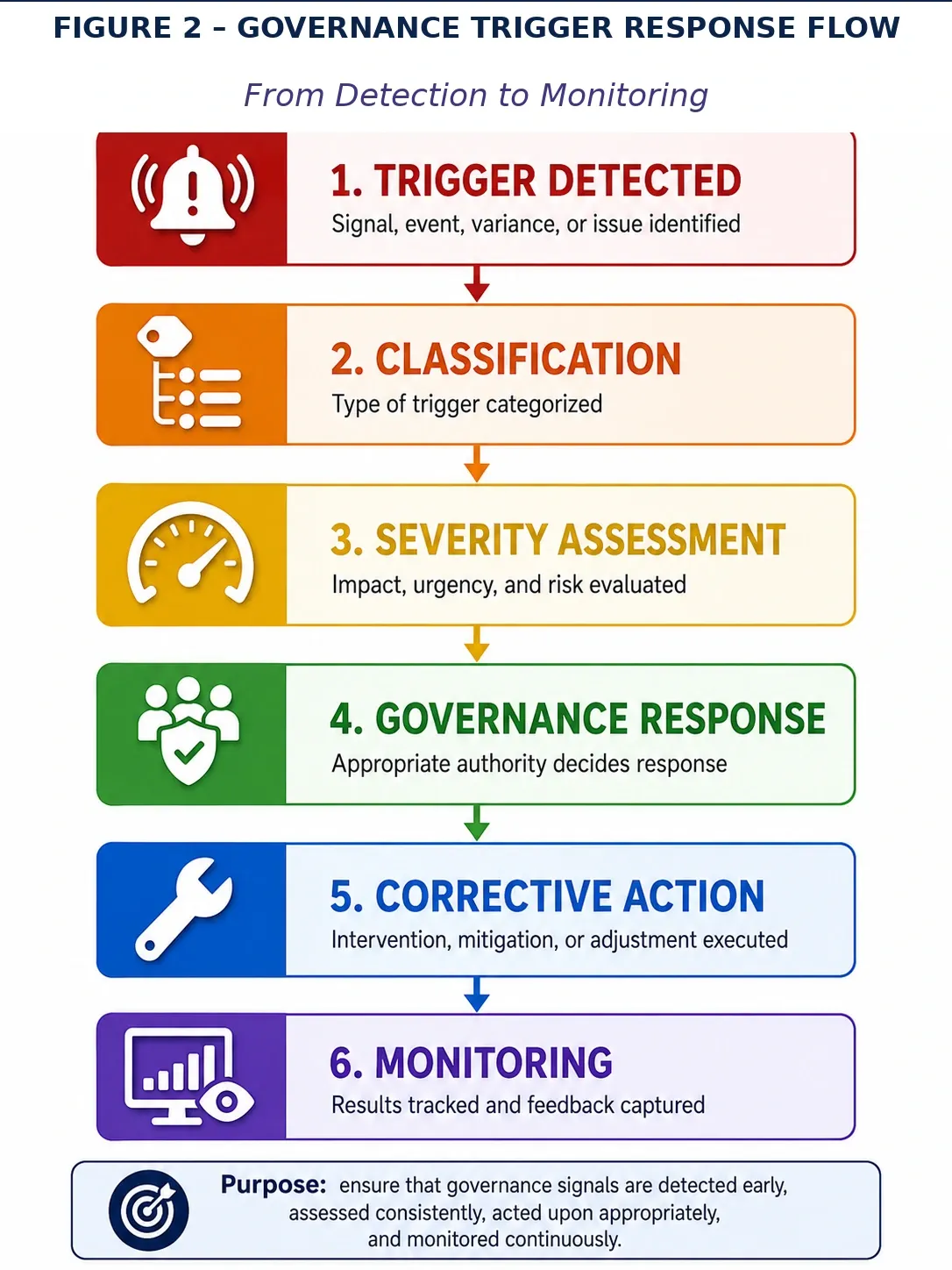
Figure 2. Governance Trigger Response Flow. A standard flow from trigger detection through classification, severity assessment, response, corrective action and monitoring.
7. Governance Trigger Categories
The operating model standardizes governance triggers into 11 categories. This resolves earlier inconsistencies between the 8-category and 11-category models and establishes one canonical model for the document set.
| Trigger Category | Example Signals | Possible Governance Response |
|---|---|---|
| Financial Triggers | ROI deterioration, NPV decline, cost overrun, operating cost escalation, vendor price increase or payback delay. | Business case reassessment, funding review, scope adjustment, portfolio reprioritization or phased deployment. |
| Operational Triggers | Model drift, degraded accuracy, system instability, service interruption or operational dependency failure. | Root-cause analysis, model retraining, operational review, contingency activation or service-level escalation. |
| Benefit Triggers | Adoption below forecast, productivity gains below target, satisfaction not improving or benefits indicators off-track. | Benefits review, adoption intervention, forecast update, business case reassessment or sponsor engagement. |
| Ethical Triggers | Bias, unfair outcome, lack of explainability, transparency concern, privacy concern or unacceptable human consequence. | Ethics review, model redesign, stakeholder consultation, human review or governance board escalation. |
| Regulatory Triggers | New regulation, compliance violation, audit finding, privacy breach, reporting obligation or sector-specific rule change. | Compliance assessment, legal review, policy update, regulatory notification or suspension of affected capability. |
| Data Triggers | Missing data, incomplete data, data quality deterioration, lineage issue, unauthorized access or data sensitivity change. | Data remediation, data governance review, retraining, access control update or quality improvement plan. |
| Vendor Triggers | Model deprecation, API price increase, service discontinuation, vendor acquisition, licensing change or SLA breach. | Vendor review, contract review, architecture reassessment, contingency planning or supplier diversification. |
| Human Impact Triggers | Resistance to adoption, workforce displacement concern, loss of trust, capability gap, user harm or complaint escalation. | Change-management intervention, retraining, stakeholder engagement, human review or adoption plan redesign. |
| Sustainability Triggers | Energy consumption increase, ESG reporting concern, social harm, inequitable access or sustainability deterioration. | Sustainability review, redesign, environmental impact assessment, ESG update or policy revision. |
| Safety Triggers | Safety event, physical harm risk, cybersecurity vulnerability, unsafe recommendation or critical system failure. | Immediate escalation, emergency shutdown, executive intervention, root-cause analysis or safety review. |
| Strategic Triggers | Strategy change, objective invalidation, duplicated capability, market shift or investment priority change. | Portfolio review, business case reassessment, initiative redesign, funding adjustment or retirement. |
7.1 Legal and Contractual Triggers
Legal and contractual concerns may appear within regulatory, vendor, ethical or safety trigger categories. They should be explicitly tracked because they can create material governance exposure.
- Legal discovery trigger
- Contractual obligation trigger
- Intellectual property trigger
- Liability exposure trigger
- Audit evidence trigger
- Data protection and privacy trigger
- Accuracy and decision-making trigger
7.2 Adoption Governance Triggers
Adoption is a governance concern, not only a deployment activity. AI-enabled initiatives should be monitored for adoption signals throughout the lifecycle.
Adoption governance should monitor:
- usage levels;
- user engagement;
- trust and confidence;
- workflow integration;
- training effectiveness;
- change readiness;
- user feedback;
- workarounds and resistance;
- stakeholder acceptance;
- realized behavior change.
Adoption triggers should activate when adoption falls below expected thresholds, trust deteriorates, users bypass the system, expected behavior change does not occur, or benefit realization depends on user acceptance that is not materializing.
Potential governance responses include change management intervention, stakeholder engagement, additional training, communication reinforcement, workflow redesign, user support, benefit reassessment, and governance review.
8. Benefit Drift Ontology
Benefit Drift is the divergence between expected benefits and realized benefits over time. Benefit drift differs from model drift. A model may continue to perform technically while benefits decline.
8.1 Benefit Drift Leading Indicators
- declining adoption
- lower usage frequency
- reduced trust
- workarounds or process circumvention
- increasing exception handling
- unresolved complaints
- benefits below trajectory
- rising operating costs
- process changes reducing effectiveness
8.2 Governance Implications
- benefits review
- root-cause analysis
- benefits forecast update
- adoption intervention
- governance escalation
- portfolio reassessment
- corrective action
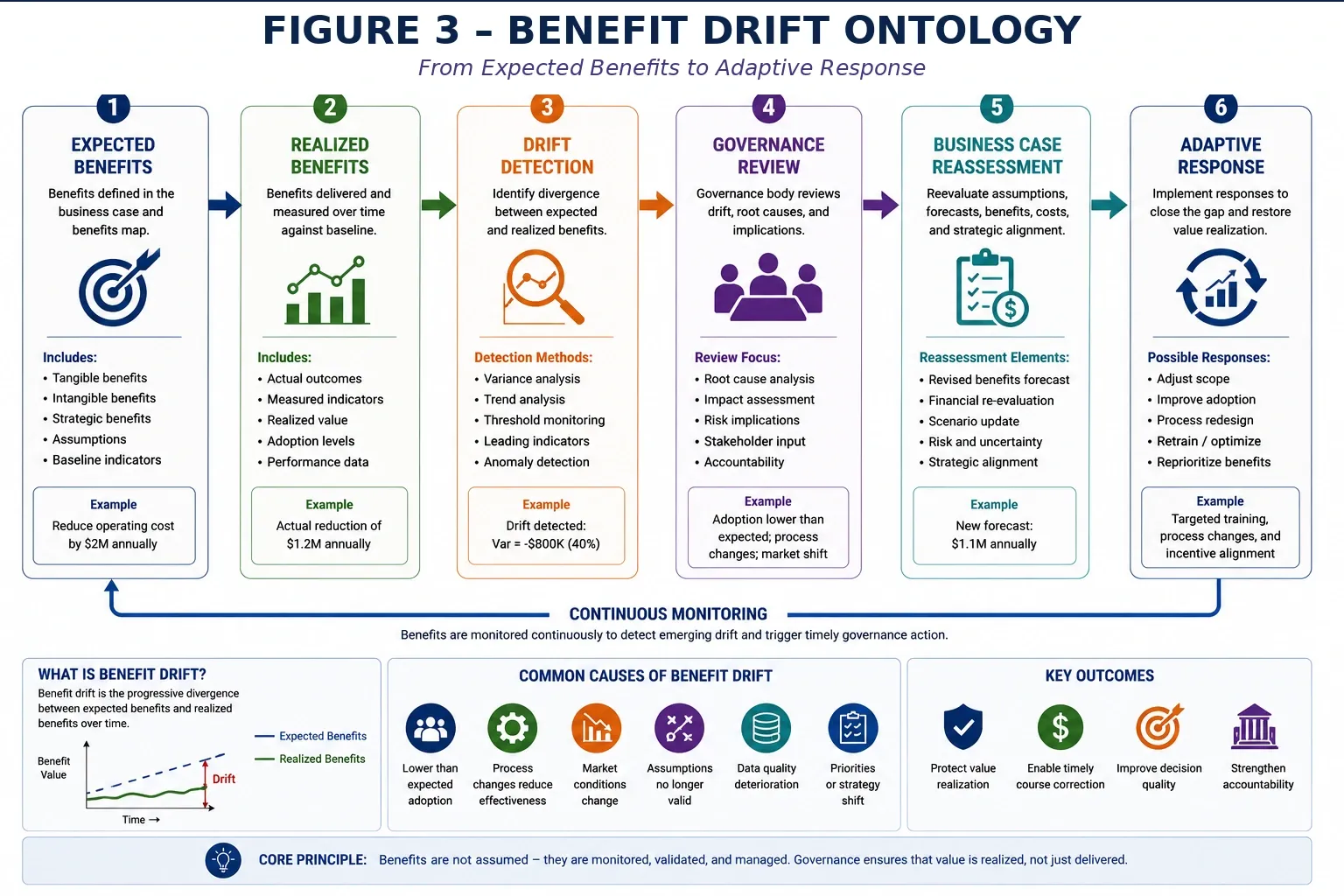
Figure 3. Benefit Drift Ontology. Expected benefits, realized benefits, drift detection, governance review, business case reassessment and adaptive response.
9. Drift Ontology
The broader drift ontology generalizes benefit drift. Drift can apply to models, data, costs, vendors, adoption, regulation, benefits and strategic assumptions. The generic drift flow is: Expected State → Observed State → Deviation → Drift Detection → Governance Response → Adaptive Action.
| Drift Type | Description |
|---|---|
| Model Drift | Model performance or behavior changes over time. |
| Data Drift | Data distribution, quality, availability or structure changes. |
| Benefit Drift | Expected benefits diverge from realized benefits. |
| Adoption Drift | Usage, trust or acceptance declines. |
| Cost Drift | Operating economics diverge from assumptions. |
| Vendor Drift | External provider changes affect capability or risk. |
| Regulatory Drift | Legal or policy obligations change. |
| Strategic Drift | Organizational priorities or objectives change. |
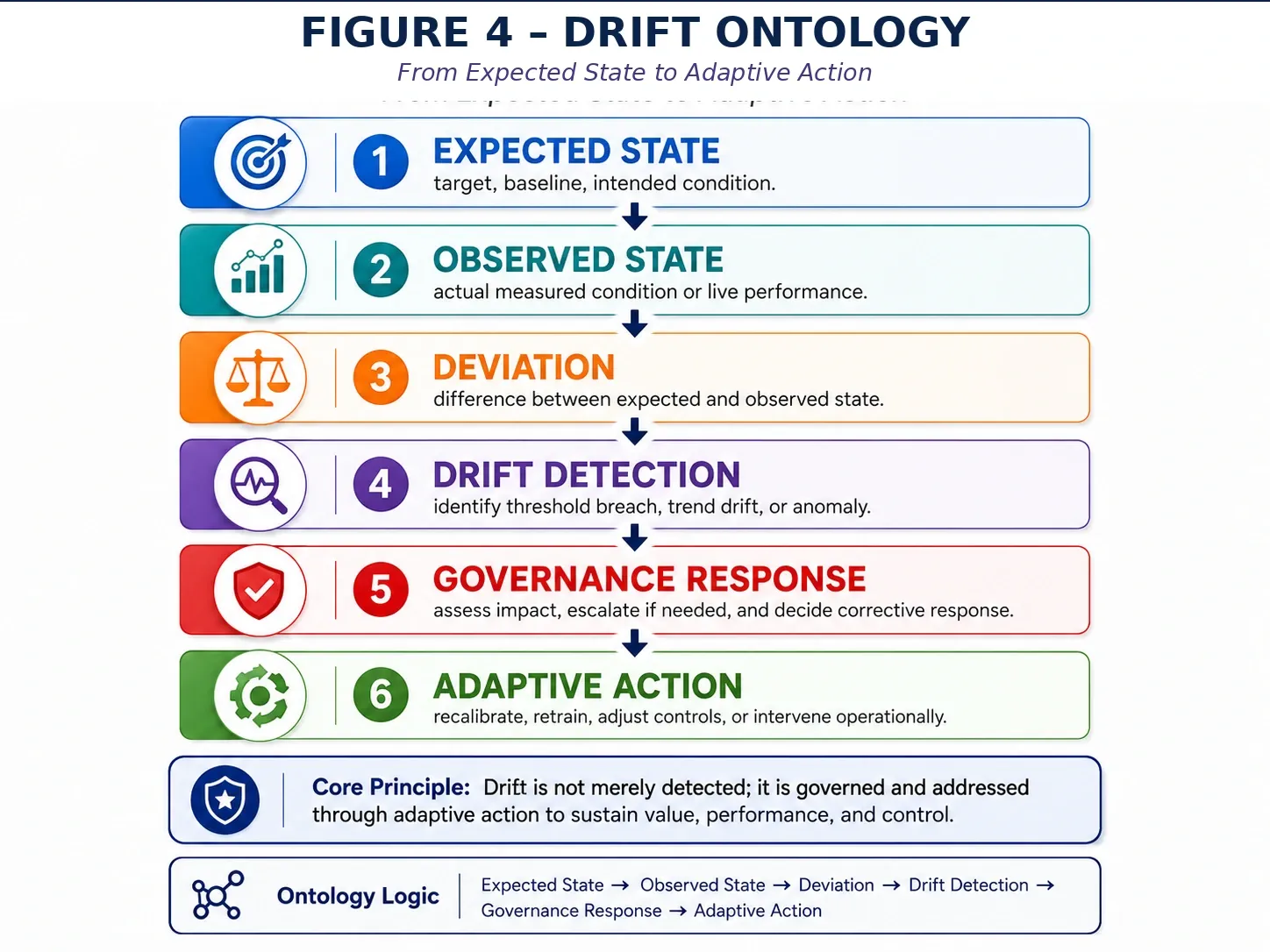
Figure 4. Drift Ontology. Expected state, observed state, deviation, drift detection, governance response and adaptive action.
10. Benefits, Uncertainty and Net Impact Governance
AI-enabled initiatives should not be governed only by delivery progress or technical performance. They should also be governed by whether expected value is being realized.
10.1 Benefits as Hypotheses
Benefits are not guaranteed. A business case may state that a system will reduce cost, improve satisfaction, increase resilience or reduce fraud losses. Those claims remain hypotheses until outcomes and benefits are measured.
10.2 Measurement Foundation
- metrics
- indicators
- proxy indicators
- baselines
- targets
- thresholds
- evidence
- benefit ownership
10.3 Uncertainty as a Governance Object
- benefit confidence
- adoption uncertainty
- forecast reliability
- ROI uncertainty
- regulatory uncertainty
- vendor uncertainty
- drift probability
- external uncertainty
10.4 AI Quality and Reliability Profile
The PMI AI Standard’s quality and reliability emphasis is incorporated through an AI Quality and Reliability Profile. This profile should be assessed before deployment and monitored throughout the lifecycle.
- data quality
- model quality
- robustness
- reliability
- explainability
- traceability
- security
- privacy
- validation
- monitoring
- maintainability
- retraining readiness
- failure handling
- auditability
10.5 Net Impact Assessment
Net Impact Assessment evaluates realized benefits, costs, risks, disbenefits, unintended consequences, sustainability effects, residual value and negative impacts. The governance decision should depend on whether the initiative continues to create positive net impact.
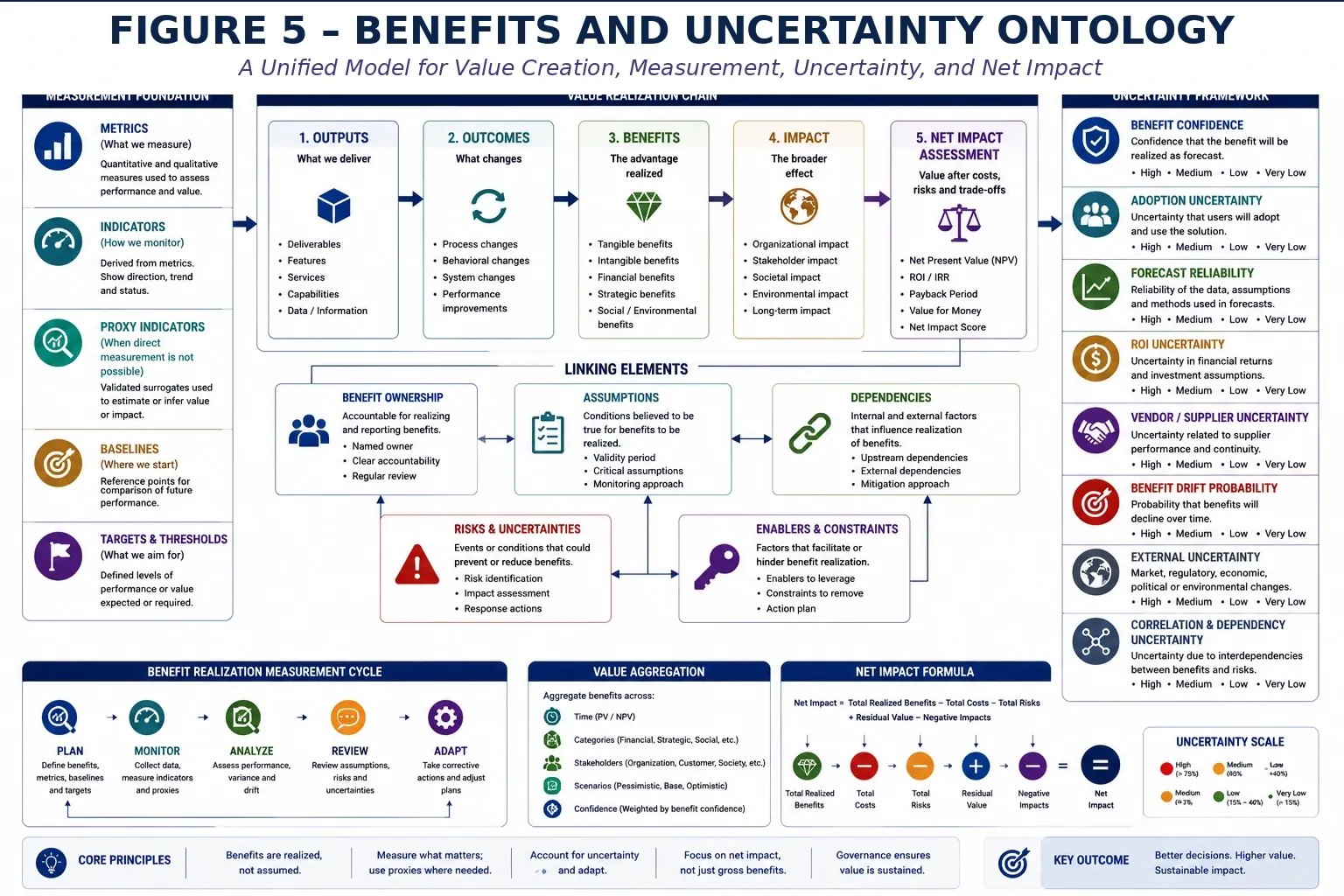
Figure 5. Benefits and Uncertainty Ontology. Benefits, indicators, financial conversion, uncertainty and net impact assessment as an integrated governance model.
11. Scenario-Based Value Assessment
Because AI-enabled initiatives operate under uncertainty, value should not be assessed using only a single forecast. Scenario-based value assessment evaluates pessimistic, base and optimistic futures.
11.1 Scenario Types
| Scenario | Description |
|---|---|
| Pessimistic Scenario | Adverse but plausible conditions: low adoption, higher costs, slower benefits, greater risk exposure. |
| Base Scenario | Most likely expected outcome: expected adoption, planned benefits, planned costs, normal risk tolerance. |
| Optimistic Scenario | Favorable but plausible conditions: high adoption, lower cost, higher benefits, faster payback. |
11.2 Expected Value
Expected Value = Σ Probability × Scenario Value. The objective is not mathematical precision. The objective is better governance judgment under uncertainty.
11.3 Decision Vocabulary Harmonization
| Decision State | Meaning |
|---|---|
| Proceed | Expected value remains positive and risks are within governance tolerance. |
| Proceed with Conditions | Proceed only with additional controls, evidence, funding limits or review gates. |
| Reassess | Assumptions, evidence or value case require further analysis. |
| Pause | Temporarily stop or defer pending corrective action or new evidence. |
| Retire / Stop | Future expected net impact is no longer positive or risk is unacceptable. |
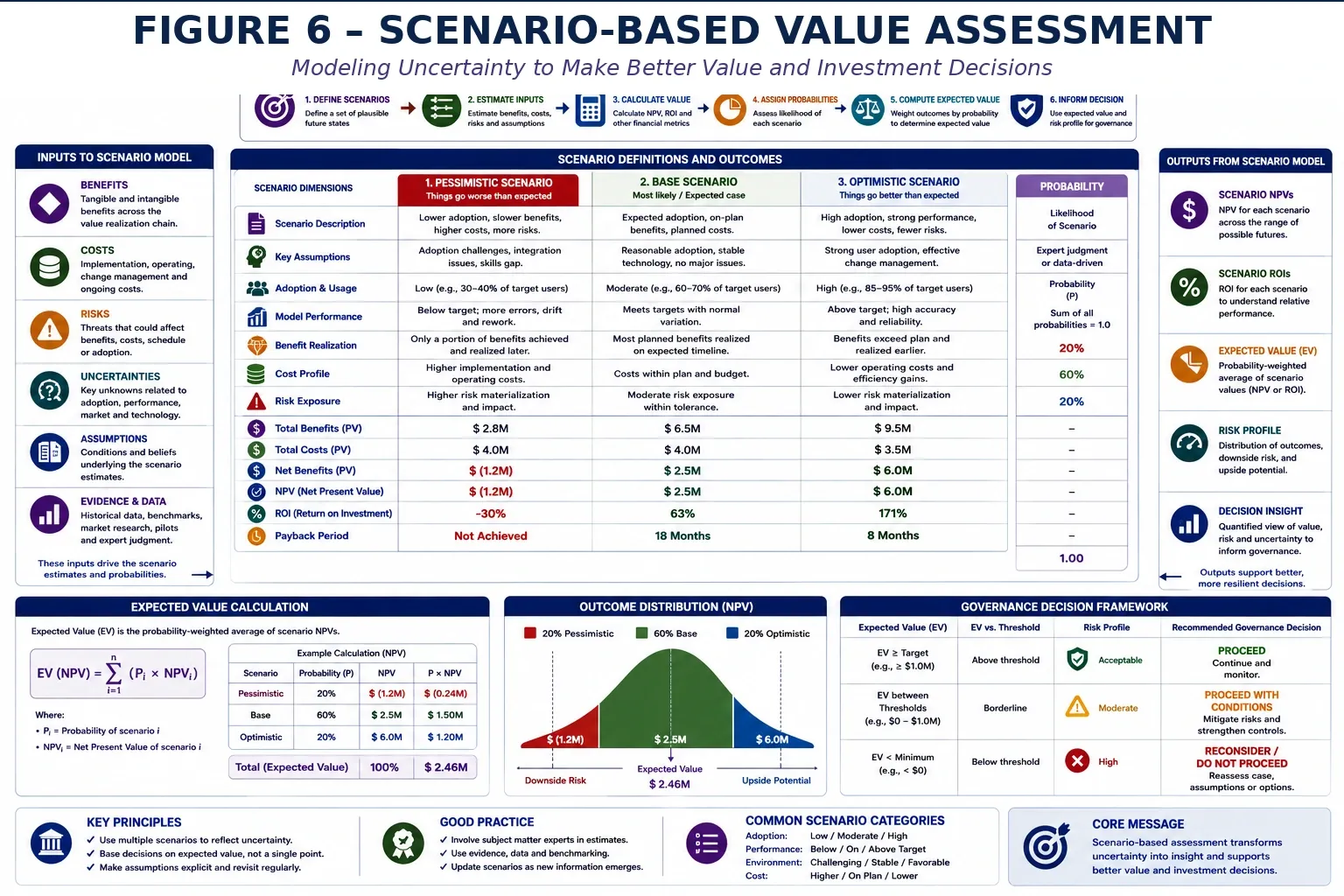
Figure 6. Scenario-Based Value Assessment. Pessimistic, base and optimistic scenarios with expected value and governance decision logic.
12. Portfolio Governance Operating Model
Most organizations manage multiple AI-enabled initiatives simultaneously. Portfolio governance is therefore essential.
The purpose of portfolio governance is not to maximize the success of individual projects, but to maximize the net impact generated by the portfolio as a whole.
12.1 Portfolio Governance Hierarchy
The hierarchy is: Portfolio → Programs → Initiatives → Projects → Use Cases → AI Capabilities.
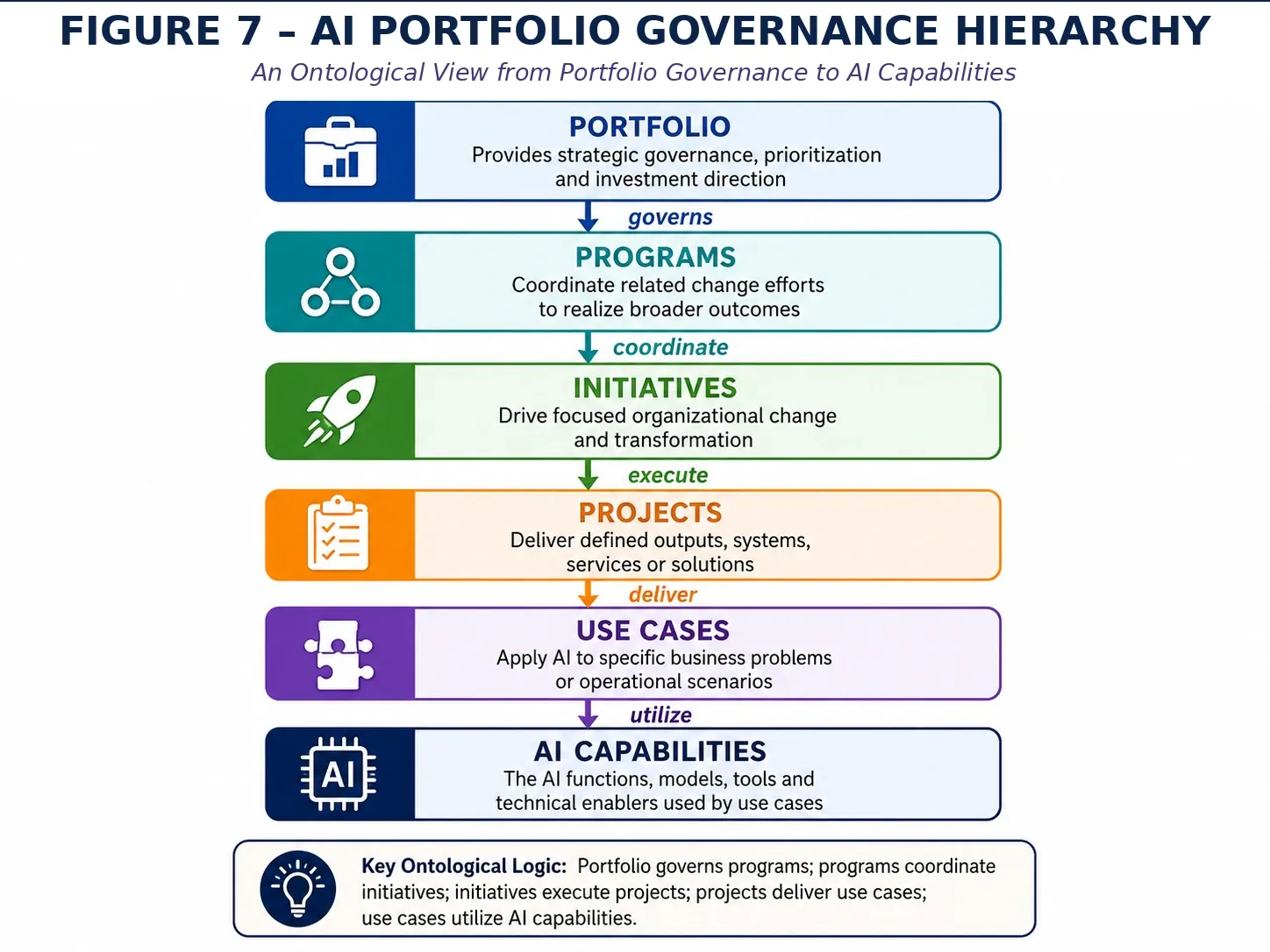
Figure 7. AI Portfolio Governance Hierarchy. Portfolio governance hierarchy from portfolio to programs, initiatives, projects, use cases and AI capabilities.
12.2 Portfolio Governance Relationships
| Relationship | Meaning |
|---|---|
| Portfolio FUNDS Program | Provides financial support. |
| Portfolio PRIORITIZES Initiative | Determines relative importance. |
| Portfolio ALLOCATES Resources | Assigns resources across initiatives. |
| Portfolio CONSTRAINS Initiative | Limits or conditions initiative execution. |
| Initiative COMPETES_WITH Initiative | Indicates competing demand. |
| Initiative SHARES Capability | Indicates capability reuse. |
| Initiative DEPENDS_ON Shared Asset | Indicates reliance on common asset. |
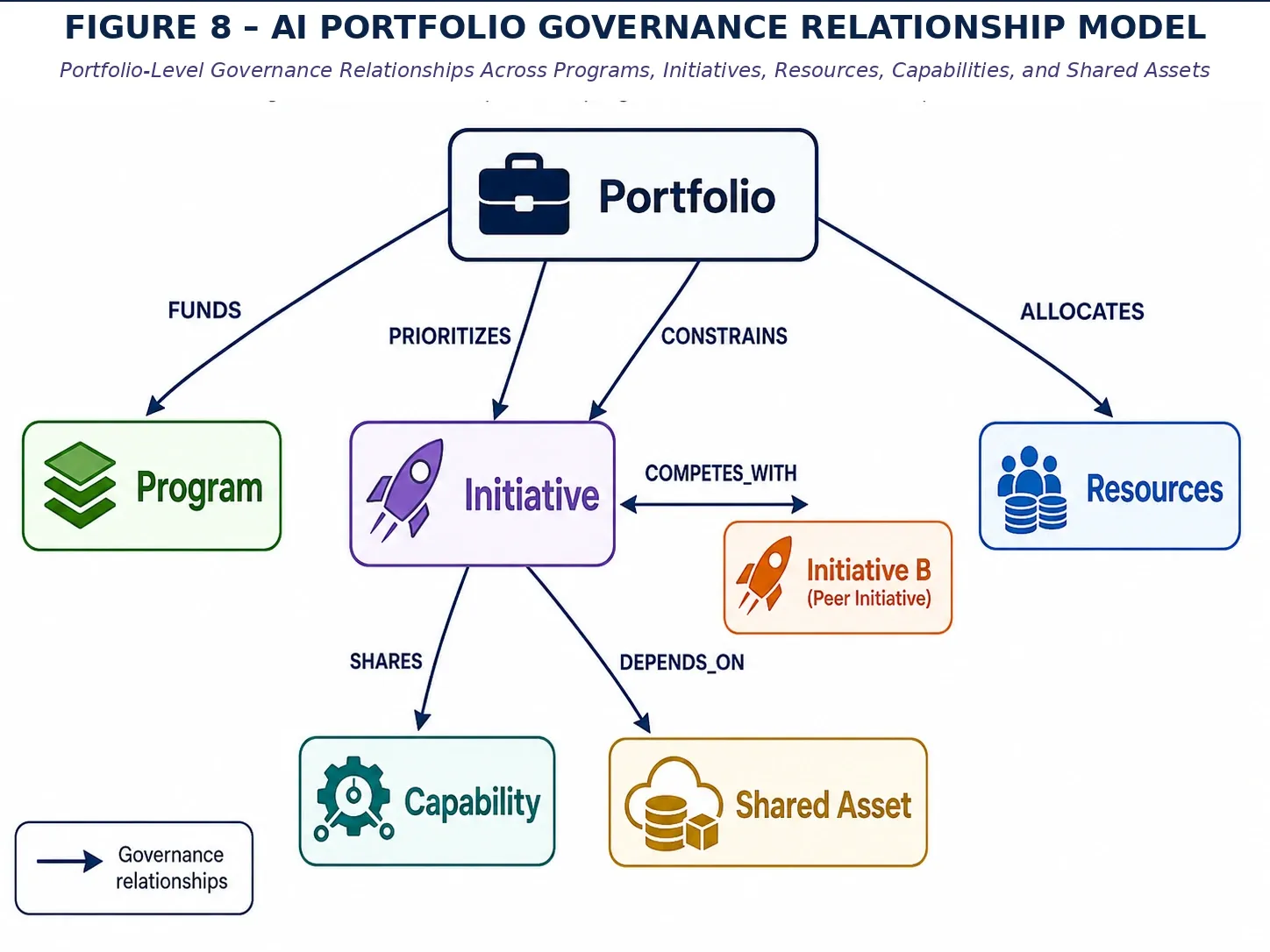
Figure 8. AI Portfolio Governance Relationship Model. Portfolio-level governance relationships across programs, initiatives, resources, capabilities and shared assets.
12.3 AI Portfolio Governance Heat Map
The operating model should also support an AI Portfolio Governance Heat Map. The heat map combines Resource 08 cost intelligence, Resource 11 benefits and ROI tracking, Resource 08 dashboard logic, PRIISM gates, and pre-commitment scoring to inform prioritization.
| Heat Map Dimension | Description |
|---|---|
| Expected Value | Expected benefits, value, ROI, NPV or net impact. |
| Uncertainty | Confidence in benefits, cost, adoption and assumptions. |
| Risk | Operational, ethical, regulatory, safety, vendor and data exposure. |
| Governance Intensity | Required level of oversight, controls and escalation. |
| Adoption Dependency | Degree to which value depends on behavior change. |
| Data Readiness | Quality, availability, sensitivity and lineage. |
| Vendor Dependency | Reliance on external models, APIs, platforms or services. |
| Legal / Ethical Exposure | Compliance, liability, IP, privacy and fairness concerns. |
| Benefit Confidence | Likelihood that benefits will materialize. |
| Strategic Alignment | Fit with organizational objectives and portfolio priorities. |
13. Human-in-Command Governance Operating Model
Human-in-Command governance is the central accountability principle of the operating model. AI may inform, recommend, optimize, automate, monitor and assist. Humans remain accountable for strategic intent, investment decisions, governance boundaries, ethical decisions, escalation, override, outcomes and impacts.
13.1 Authority Levels
| Authority Type | Role |
|---|---|
| Strategic Authority | Sets direction: objectives, investments, portfolio priorities and risk appetite. |
| Governance Authority | Sets guardrails: policies, compliance, ethics, auditability and controls. |
| Operational Authority | Manages execution: project delivery, monitoring, incident management and corrective action. |
| Override Authority | Intervenes: suspension, emergency stop, exception decisions and deployment restriction. |
| Value Owner | Owns business value: validates benefit assumptions, challenges deteriorating value and can recommend stop/pause/adapt decisions. |
13.2 Human-in-Command Evidence Requirements
Human-in-Command should be evidenced, not merely asserted. Required evidence includes named authorities, decision logs, approval records, override logs, escalation trails, benefit ownership records, review minutes and accountability confirmation.
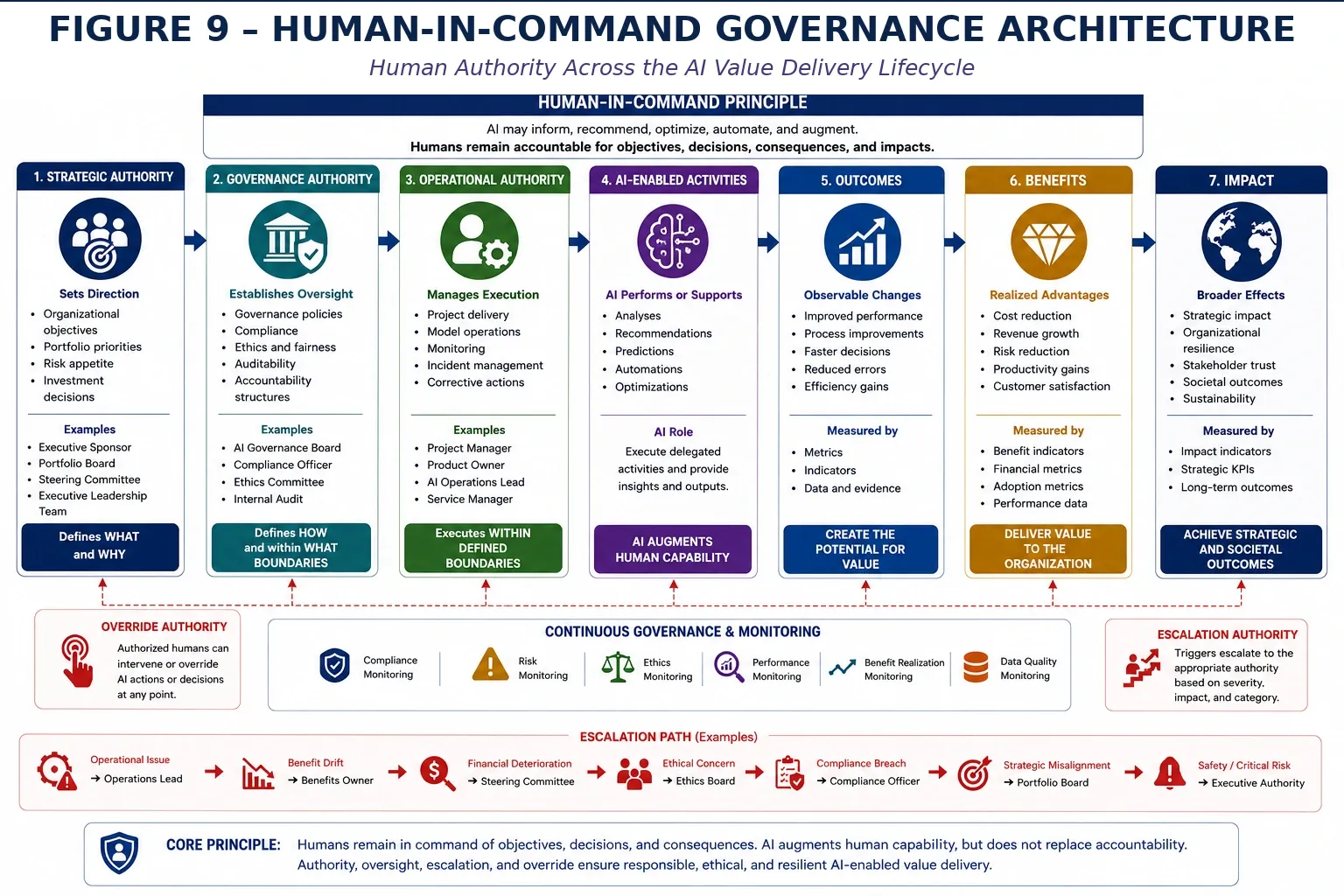
Figure 9. Human-in-Command Governance Architecture. Strategic, governance, operational and override authority across the AI value delivery lifecycle.
14. Escalation Ontology and Authority Matrix
Escalation is not failure. Escalation is a governance mechanism. The escalation ontology ensures that triggers are routed to the appropriate authority according to category, severity, urgency and consequence.
14.1 Escalation Flow
Trigger Detected → Severity Assessment → Escalation Authority → Governance Action.
14.2 Authority Mapping
| Trigger | Escalation Category | Authority |
|---|---|---|
| Model Drift | Operational Escalation | Operations Lead |
| Benefit Drift | Benefit Escalation | Benefits Owner |
| ROI Deterioration | Financial Escalation | Steering Committee |
| Vendor Failure | Governance Escalation | Governance Board |
| Ethical Incident | Ethical Escalation | Ethics Board |
| Compliance Breach | Regulatory Escalation | Compliance Officer |
| Safety Concern | Executive Escalation | Executive Authority |
| Strategic Misalignment | Strategic Escalation | Portfolio Board |
| Adoption Failure | Benefit / Change Escalation | Program Sponsor |
| Data Quality Breakdown | Data Governance Escalation | Data Governance Lead |
14.3 Escalation Principles
- early
- proportionate
- evidence-based
- authority-aligned
- transparent
- traceable
- accountable
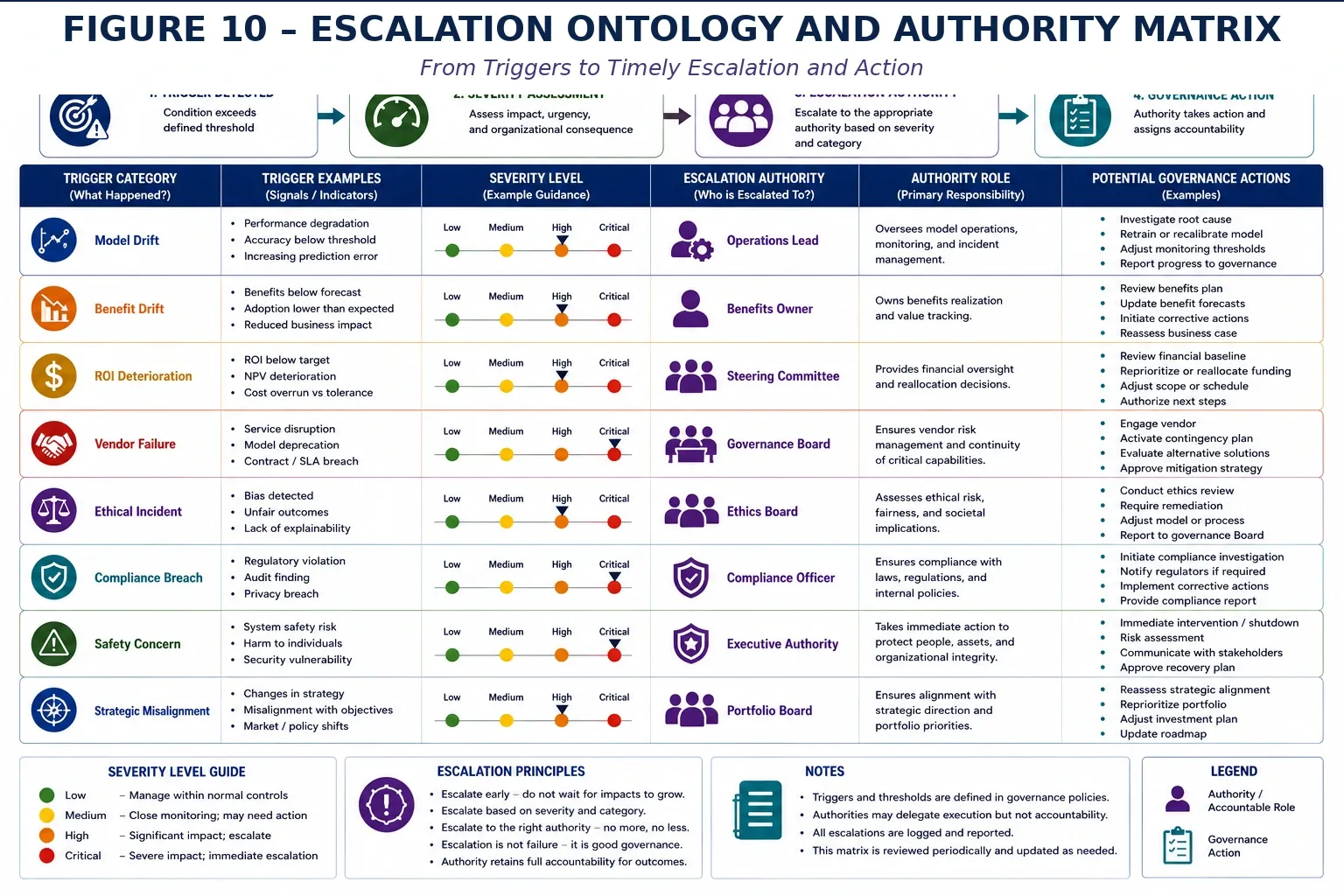
Figure 10. Escalation Ontology and Authority Matrix. Trigger detection, severity assessment, authority mapping and governance action.
15. Human Override Mechanisms
Human override mechanisms are safeguards that ensure meaningful human control remains possible throughout the AI lifecycle. Override should be designed before deployment, not improvised during crisis.
- approval checkpoints
- human validation requirements
- escalation gates
- emergency shutdown authority
- deployment suspension authority
- manual override
- exception approval
- rollback authority
Override mechanisms are especially important for high-impact AI, regulated AI, autonomous AI, safety-critical contexts and AI that affects people’s rights, access, financial standing or legal consequences.
16. Lifecycle Governance Flow
AI governance should cover the full lifecycle. The updated lifecycle aligns the AIPM operating model with PMI’s AI lifecycle and tailoring guidance.
| Lifecycle Stage | Governance Focus |
|---|---|
| Business Justification | Strategic alignment, business case, expected benefits, risk appetite, uncertainty and value proposition. |
| Initiative Design and Scope Definition | Capability design, value stream definition, governance profile, adoption strategy and authority model. |
| Data Collection and Preparation | Data quality, availability, lineage, sensitivity, ownership and readiness. |
| AI Capability / Model Development | Model development, validation, testing, explainability, security and technical readiness. |
| Deployment and Adoption | Controlled rollout, change management, user training, stakeholder communication and adoption tracking. |
| Operations, Monitoring and Evaluation | Model performance, data quality, benefits, cost, adoption, risks, incidents and triggers. |
| Optimization and Iteration | Retraining, recalibration, process redesign, benefit recovery and control adjustment. |
| Adaptive Governance | Governance response to drift, changes in assumptions, value deterioration or strategic shifts. |
| End-of-Life, Decommissioning or Retirement | Retirement, transition, data retention, documentation, lessons learned and residual risk management. |
| Continuous Value Delivery | Sustained outcomes, benefits, impacts, learning and continued impact justification. |
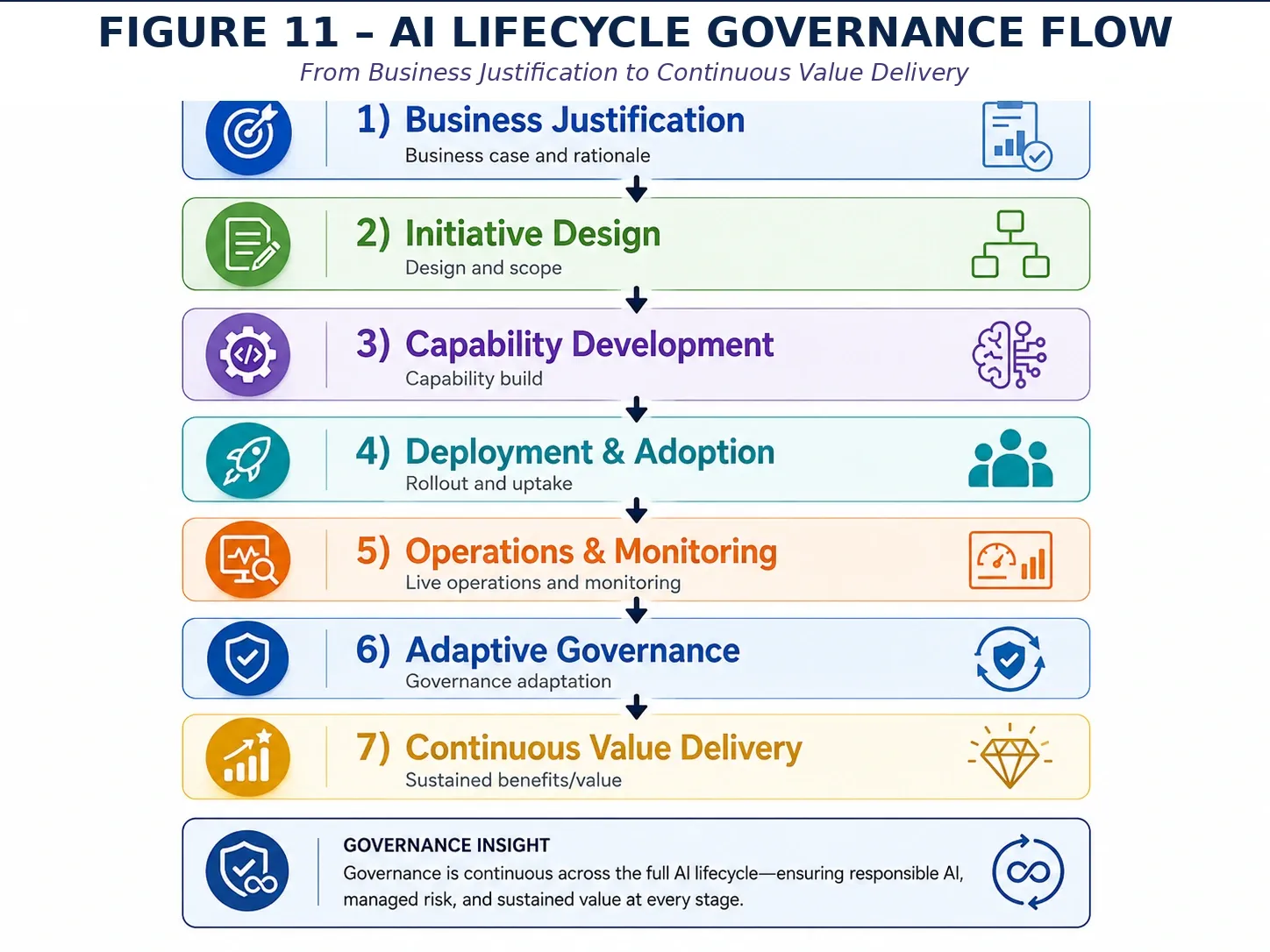
Figure 11. AI Lifecycle Governance Flow. Lifecycle governance from business justification to continuous value delivery.
Check Results – Lifecycle Governance
✓ Is the initiative still aligned with organizational objectives?
✓ Are data, model, adoption and benefits being monitored?
✓ Are change management and organizational readiness actively managed?
✓ Is there evidence of continued positive net impact?
✓ Are retirement or adaptation criteria defined?
17. Continuous Impact Justification
AI-enabled initiatives should continue only while expected future net impact remains positive. This extends continued business justification into a continuous impact logic.
The decision flow is: Impact Assessment → Net Impact Review → Continue? → Yes: Continue / No: Adapt or Retire.
17.1 Impact Assessment
- outcomes
- benefits
- disbenefits
- costs
- risks
- stakeholder consequences
- sustainability effects
- unintended impacts
17.2 Net Impact Review
Determine whether the initiative’s net impact is positive, neutral, negative or uncertain.
17.3 Continue Decision
If net impact remains positive, continue, monitor, optimize or scale. If net impact is no longer positive, adapt, redesign, reduce scope, pause or retire.
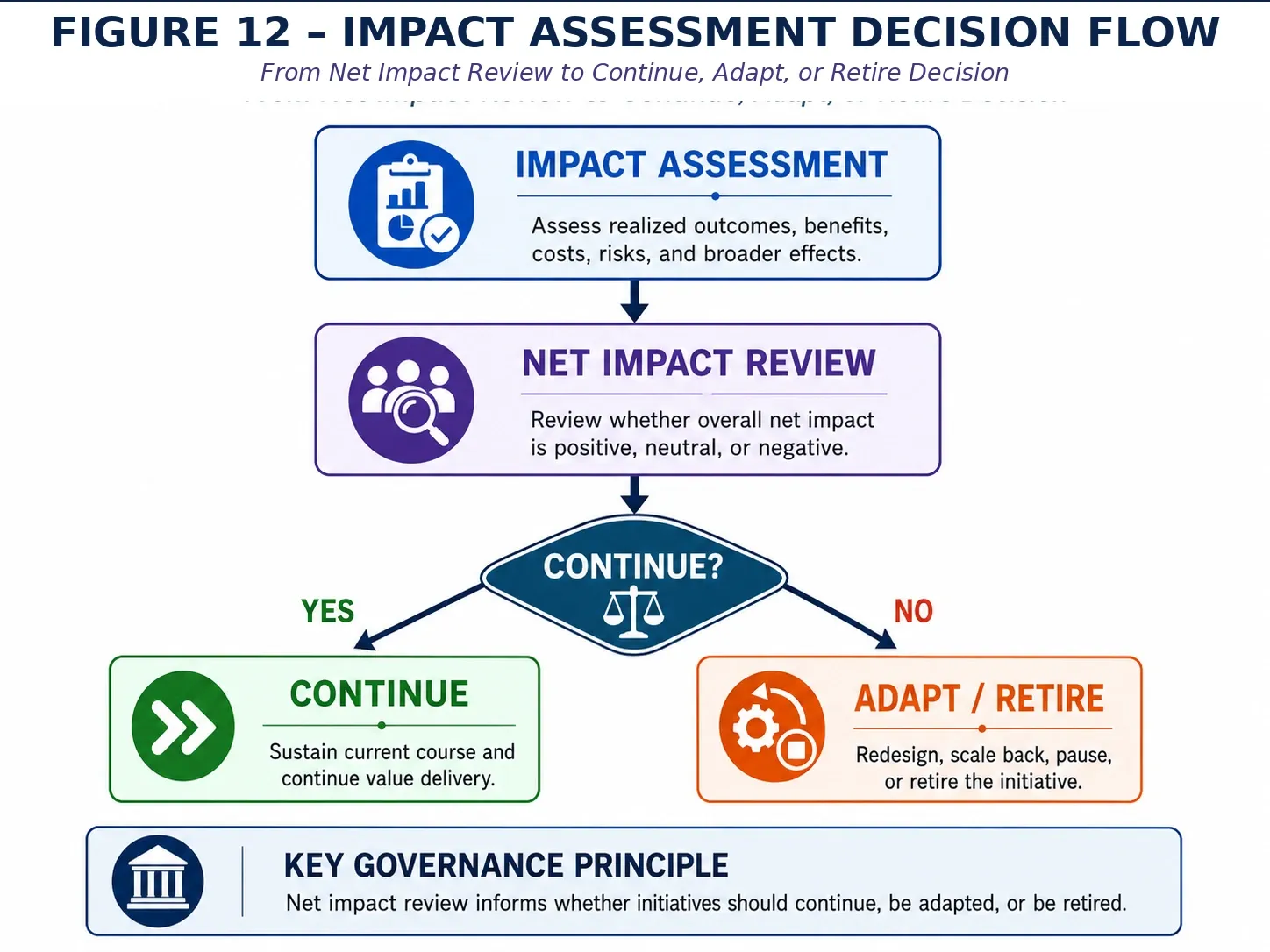
Figure 12. Impact Assessment Decision Flow. Net impact review informing continue, adapt or retire decisions.
18. Monitoring and Governance Metrics
Governance requires evidence. Monitoring should include both leading and lagging indicators.
18.1 Monitoring Domains
- model performance
- data quality
- operational performance
- user adoption
- benefits realization
- financial performance
- risk exposure
- compliance
- ethical performance
- human impact
- sustainability
- vendor dependency
18.2 Leading Indicators
- declining adoption rate
- increasing user complaints
- early model performance degradation
- data quality warning
- increasing processing cost
- unresolved incidents
- vendor roadmap change
- regulatory consultation
18.3 Lagging Indicators
- realized cost overrun
- confirmed benefit shortfall
- compliance breach
- confirmed model failure
- audit finding
- customer dissatisfaction
- operational outage
18.4 Governance Dashboards
Governance dashboards should summarize status, benefits, risks, triggers, escalations, corrective actions, unresolved issues, decision points and responsible owners. Dashboards should support governance decisions, not merely reporting.
19. Roles and Responsibilities
| Role | Responsibilities |
|---|---|
| Executive Sponsor | Strategic alignment, investment justification, sponsorship, executive issue resolution and continued value focus. |
| Portfolio Board | Prioritization, funding allocation, resource trade-offs, portfolio balancing and portfolio net impact. |
| AI Governance Board | Policy, oversight, ethics, compliance, governance controls and escalation resolution. |
| Value Owner | Business value accountability, benefit validation, challenge to failed assumptions and stop/pause/adapt recommendations. |
| Benefits Owner | Benefit definition, measurement, realization, benefit drift review and corrective action. |
| Project or Initiative Manager | Delivery coordination, issue management, reporting, governance integration and escalation support. |
| Product or Business Owner | Value stream alignment, user needs, adoption, business acceptance and outcome realization. |
| Data Owner | Data quality, availability, lineage, sensitivity and governance. |
| Model Owner | Model performance, validation, retraining, monitoring and technical lifecycle management. |
| Risk, Compliance and Ethics Roles | Risk monitoring, compliance review, ethics review, audit evidence and regulatory alignment. |
| Human Authority | Decisions, approvals, escalations, overrides and accountability. |
20. Governance Operating Rhythm
| Governance Review | Purpose |
|---|---|
| Initiation Review | Confirms strategic alignment, business case, governance profile, expected benefits, risk appetite and human accountability. |
| Design Review | Confirms value stream design, data readiness, control requirements, adoption strategy and ethical implications. |
| Pre-Deployment Review | Confirms model validation, operational readiness, user readiness, governance controls, monitoring setup and override mechanisms. |
| Operational Review | Confirms performance, adoption, cost, benefit realization, incidents, risks and triggers. |
| Benefits Review | Confirms expected versus realized benefits, benefit drift, impact evidence, financial conversion and corrective action. |
| Portfolio Review | Confirms portfolio alignment, resource conflicts, capability duplication, shared asset dependency and aggregate net impact. |
| Retirement or Adaptation Review | Confirms continued justification, net impact, alternative options and adaptation or retirement decision. |
21. PRIISM, Lifecycle Cost, Benefits and Decision-Support Integration
The operating model integrates the Toolkit resources as complementary layers of governance evidence and decision support.
21.1 PRIISM as Financial Authority Layer
PRIISM strengthens the financial governance question: is the initiative still worth funding? It connects probabilistic assessment, responsibility, investment range, sustainability cost, and model decay planning.
| PRIISM Component | Governance Role |
|---|---|
| P – Probabilistic Gate | Evaluate future value under uncertainty and scenario assumptions. |
| R – Responsibility | Assign named accountability for value, cost, risk and funding decisions. |
| I – Investment Range | Evaluate investment exposure, affordability and funding boundaries. |
| S – Sustainability Cost | Incorporate ongoing cost, operating burden and ESG-related cost. |
| M – Model Decay Plan | Plan for drift, retraining, maintenance and eventual replacement or retirement. |
21.2 Resource 08 — Lifecycle Cost and Investment
Resource 08 provides lifecycle cost, hidden-cost, sustainability-cost, scenario-costing, and model-decay inputs. These inputs support PRIISM, scenario-based value assessment, and portfolio heat mapping.
21.3 Resource 11 — Benefits and ROI Tracking
Resource 11 provides benefits and ROI tracking logic using baselines, KPIs, targets, actual values, variance, benefit owners, and lifecycle benefit review. These elements support benefit-drift monitoring and net-impact governance.
21.4 Resources 08 and 10 — Lifecycle Decision Support and Financial Authority
Resources 08 and 10 support business-case review, assumption stress testing, cost validation, benefit-drift detection, funding recommendations, and portfolio reallocation. They provide decision support and financial-authority logic; accountable human authorities retain approval and decision rights.
21.5 Pre-Commitment Scoring Grid
The pre-commitment scoring grid supports early readiness assessment and can be used before PRIISM or portfolio gate decisions. It helps identify whether an initiative is ready, conditionally ready or not ready for further investment consideration.
22. Operating Model Summary
The AI Governance and Value Delivery Operating Model transforms the conceptual ontology and taxonomy into a practical governance system.
It provides the mechanisms required to detect governance signals, classify triggers, assess severity, escalate issues, assign authority, enable human override, monitor benefits, assess uncertainty, govern drift, manage portfolio dependencies, govern the lifecycle and continuously validate net impact.
The operating model reinforces a central principle: AI governance is not merely control. It is the continuous stewardship of responsible value delivery under uncertainty.
Selected References
Project Management Institute. The Standard for Artificial Intelligence in Portfolio, Program, and Project Management. PMI, 2026.
Project Management Institute. A Guide to the Project Management Body of Knowledge (PMBOK® Guide) – Eighth Edition. PMI, 2025.
AIPM Ambassador Review Comments and Suggestions on the AI Governance and Value Delivery Framework.
Historical Source Artifacts Used in Development
The following legacy team, stream, and source-version labels are retained solely for provenance and do not describe the current Toolkit structure.
InterTeam Alignment Brief, June 2026.
PRISM Developed by Jasem El Baigi.
Team 2 AI Project Cost-Investment Model v.632.
Team 3 Benefits and ROI Tracking Outline.
Team 4 AI Financial Decision Framework V1.